RELATIVITY REALLY SIMPLE
LIGHT WAVES
Pre-Einstein light was thought of as waves propagating through a “medium” called “aether” that permeated all matter in the universe. Quite an alchemistic theory of matter! The real physical cause of that phenomenon was not understood.
The wrong paradigma for light waves
The paradigma to visualize (i.e. think about) that wave in aether that came to mind was water waves caused by a stone thrown into a pond at a particular spot. Then the water ripples in waves away from that spot at a specific speed (say: c) and specific wavelength. And if an observer travels along the wave at a certain speed (say: v) he will observe the same wavelength but a smaller speed c-v.
Then came the Michelson-Morley-experiment in 1867 that failed to prove the existence of aether.
The correct paradigma for light waves
The above paradigma is wrong in two respects.
First of all, the phenomenon “light” doesn’t require a medium “to travel” from its source to an observer (i.e. measurement instrument.) Light from stars reaches the retina of our eyes without any physical “matter” intermediate. That reality is difficult to comprehend as it sounds like pure magic. (Similarly, Newton could not accept that gravitational pull happened without the presence of some physical intermediate.)
Secondly, if one still wants to use a physical paradigma to elucidate light waves, consider the following:
Throw a stone in a very viscose liquid resulting in just one crest that starts traveling away from the spot where the stone hits the liquid. Then, after some time, throw a second stone at the same spot in the liquid. Then a third, and so on at a particular frequency. So, you get a series of crests (a wave length apart) traveling at a certain speed “c” in the liquid.

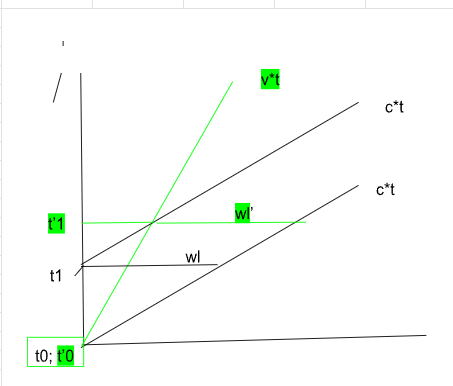
See graph below: the wave length is “wl” and the frequency is determined by ”t1 – t0” and thus the speed of propagation is “c”.
But what does an observer traveling along with the wave at a speed “v” observe (measure?) He sees a time gap between the first and second wave crest equal to “t’1 – t’0” and at the moment he “sees” the second crest the first has traveled further along so that he observes a wave length of “wl’”. In other words, the wave length increases and the frequency decreases (i.e. the time gap between wave crests increase). Thus, any observer traveling along with the series of crests will observe the same speed “c”.
The physical cause of light.
“An electron repulses another electron, at any distance apart, without the intervention of any physical “matter” intermediate.” The repulse effect is not instantaneous.”
As a result, an oscillating electron will cause other electrons to oscillate in the opposite direction (up-down cause down-up)
So, if an electron oscillates at a particular frequency it creates a series of impulses that make oscillate other electrons (however far away). Such an impulse we call “photon” (RIGHT?). As the repulse effect is not instantaneous, the frequency determines the distance apart (i.e.wave length) between two impulses.
Another paradigma for the phenomenon is to think of this series of photons as a series of massless particles travelling through space.
THE PRINCIPLE OF RELATIVITY
There are two phenomena of matter, gravitation and electromagnetism, that for observers moving at any speed relative to each other are observed (measured) in the same way:
Gravitation: the acceleration of a falling stone is the same for all observers, irrespective of their moving speed relative to each other.
Light: The speed of propagation of light impulses (photons) is the same for all observers, irrespective of their moving speed relative to each other.
THAT’S ALL THERE IS TO IT!!!


